
Reclaiming the Secret Places
The Return to the Inner Temple is live today on Amazon.

The Return to the Inner Temple is live today on Amazon.
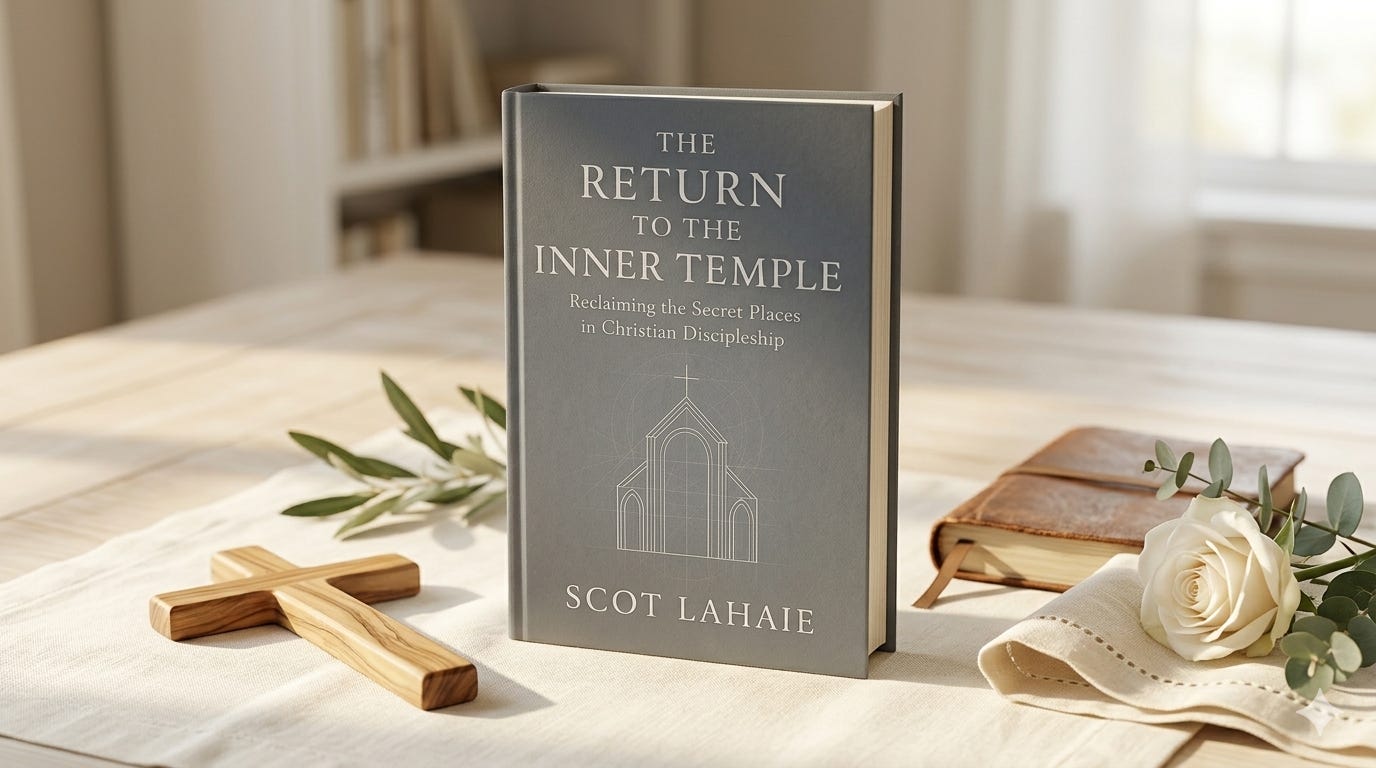
Some readers of Arrow Song may know that alongside the essays published here on biblical languages, theological history, and the philosophical grounding of Christian belief, I have been at work on a longer project of practical theology. That project arrives today in book form.
The Return to the Inner Temple: Reclaiming the Secret Places in Christian Discipleship is written for the reader who suspects there is more to Christian discipleship than the modern Church has been offering, and who is willing to think carefully about what that more might be. The central claim is that the moné Jesus promised in John 14 is not a euphemism for postmortem lodging in heaven, but a present interior reality prepared for the believer in this life, accessible through the spirit rather than the soul, and integral to the tripartite anthropology assumed throughout the New Testament.
The book traces this reality through Scripture, through the mystical tradition from the Desert Fathers to Julian of Norwich to Teresa of Ávila, and into a practical map of what it looks like to cross the threshold and abide in the place Christ prepared. It is careful, at various points, to distinguish this theology from New Age framings that superficially resemble it. Interiority is not solipsism. The Inner Room is not an altered state of consciousness or an imaginative construct. It is a real dwelling place, established by Christ, indexed to the biblical witness, and testified to by the great tradition of Christian mystics across two millennia.
The philosophical grounding for such a claim is more robust than contemporary theology has generally acknowledged, and readers of Arrow Song will recognize some of the tools that would be brought to bear on it. Michel Henry’s phenomenology of life is one such tool, and future essays here will engage that work as one contemporary voice offering rigorous support for what the mystics knew directly. The book itself does not attempt that particular philosophical argument in depth, but it does open the ground on which such an argument can be built.
Through July 21st, the book is available at the reduced launch price of $10.00.
If the book proves useful to you, an honest review on Amazon during launch week helps other readers find it. That is how books like this reach the audiences they were written for.